

Your animal helps you manage a mental health-related disability, but does that make them an emotional support animal or a psychiatric service dog? And does the difference change where they can live, travel, or accompany you?
This ESA vs. PSD guide gives you the practical answer. Compare training requirements, housing accommodations, public access rights, air travel, and documentation, then use those differences to understand which path may fit your situation. Start with the side-by-side comparison below.
How Do an ESA and a Psychiatric Service Dog Compare?
An ESA and a psychiatric service dog differ most in task training and the rights that follow in different settings. Here is how ESAs and PSDs compare at a glance:
| Comparison | Emotional Support Animal (ESA) | Psychiatric Service Dog (PSD) |
|---|---|---|
| Primary role | Provides disability-related emotional support through its presence | Performs trained tasks related to a psychiatric disability |
| Task training | No disability-related task training required | Individually trained to perform disability-related work or tasks |
| Animal type | Can include animals other than dogs, depending on the applicable housing rules | A dog under ADA service animal rules |
| ADA status | Not considered a service animal under the ADA | Considered a service animal when ADA requirements are met |
| Public access | No general ADA right to enter places where pets are prohibited | Generally permitted in public places under the ADA when service animal requirements are met |
| Housing | Protections depend on applicable housing laws and circumstances | Stronger treatment under HUD’s current FHA enforcement approach |
| Air travel | Airlines are not required to recognize ESAs as service animals | Qualifying PSDs may travel as service animals under U.S. DOT rules |
| Documentation | Supporting information may be requested for some housing accommodations | A letter or certificate does not establish ADA service animal status; documentation requirements vary by setting |
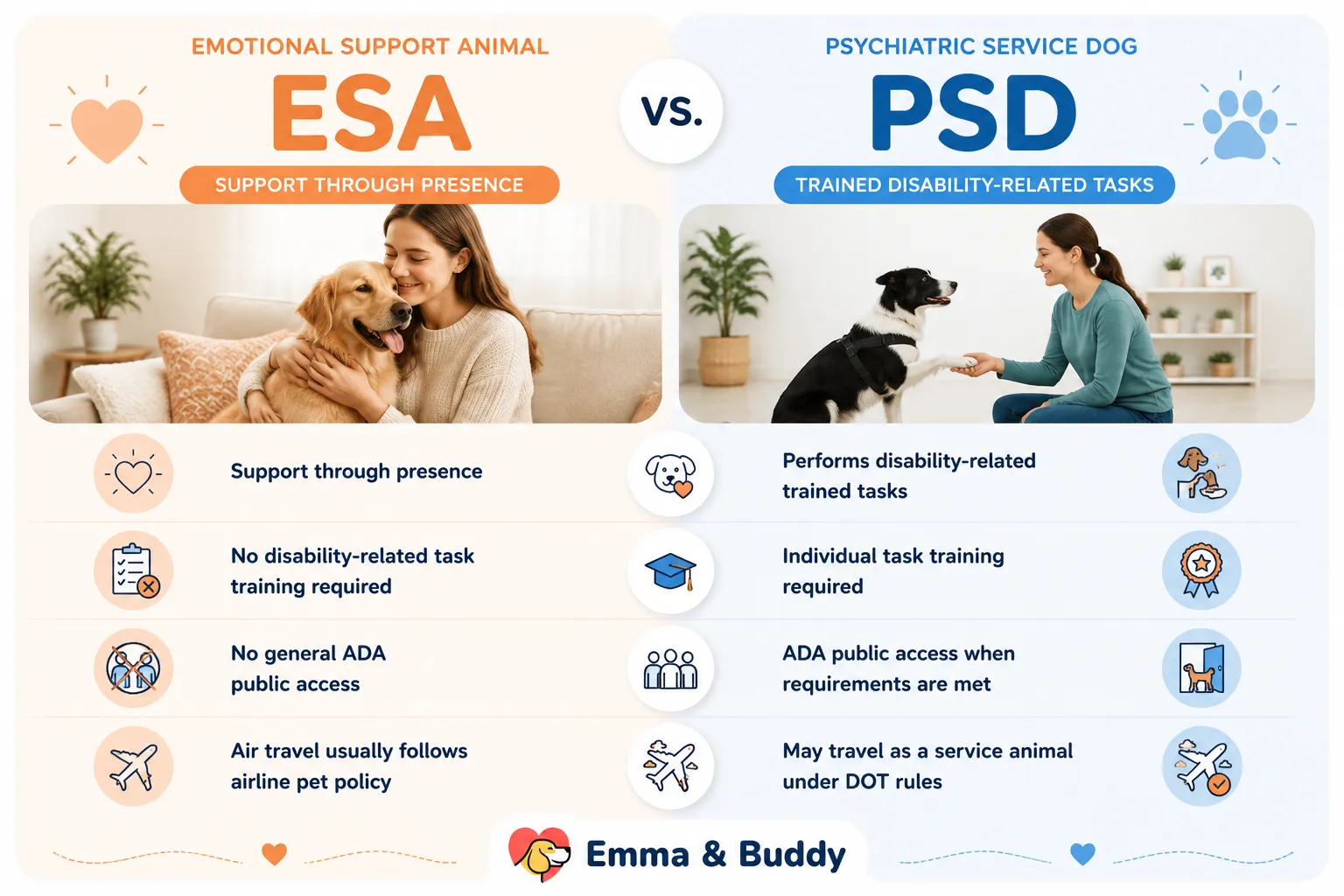
The most important distinction is not the label or paperwork attached to the animal. It is whether the animal provides emotional support through its presence or a dog is individually trained to perform disability-related tasks. The sections below explain what that difference means in practice.
What Is an Emotional Support Animal (ESA)?
An emotional support animal (ESA) provides comfort and companionship that help with the effects of a person’s disability. The animal’s presence provides the support; an ESA does not need to be individually trained to perform disability-related tasks.
This is why an ESA is different from a service animal under the Americans with Disabilities Act (ADA). ESA status does not provide general public-access rights to places such as restaurants, stores, or other businesses where pets are prohibited. Housing protections for ESAs are more complex and can depend on the applicable law and circumstances. HUD’s current FHA enforcement approach no longer presumes that pet-policy accommodations for untrained ESAs are reasonable.
For example, someone whose animal helps ease disability-related symptoms at home may need a housing accommodation even though the animal does not perform a trained task or accompany them into public places.
Considering an ESA for housing? See how ESA documentation for housing works and what to know about current housing requirements.
What Is a Psychiatric Service Dog (PSD)?
A psychiatric service dog (PSD) is a service dog individually trained to perform work or tasks related to a person’s psychiatric disability. The trained action must help with the effects of that disability rather than provide comfort through the dog’s presence alone.
Depending on the handler’s disability-related needs, a PSD may be trained to:
- Remind the handler to take medication
- Interrupt certain disability-related behaviors
- Guide a disoriented handler to a safe location
- Perform a trained response during a psychiatric episode
Does a Psychiatric Service Dog Need Professional Training?
No. The ADA does not require a psychiatric service dog to be trained through a professional service dog program. A person with a disability may train the dog themselves. However, the dog must be individually trained to perform work or tasks related to the person’s disability; providing comfort through its presence alone is not enough.
A qualifying psychiatric service dog is considered a service animal under the Americans with Disabilities Act (ADA). This distinction can provide public-access protections that do not apply to emotional support animals, although the dog must still meet applicable ADA requirements, including remaining under control.
We’ll cover PSD documentation separately below because a letter, certificate, or registration is not what makes a dog a psychiatric service dog.
What Is the Biggest Difference Between an ESA and a PSD?
The defining difference is not whether an animal makes you feel better. Both an ESA and a psychiatric service dog can provide comfort and companionship. What distinguishes a PSD is that the dog is individually trained to take a specific action related to the handler’s disability.
A simple way to tell the difference is to ask: What does the animal do when support is needed?
- Emotional support: Your animal’s presence or companionship helps ease disability-related symptoms, but the animal has not been trained to respond with a specific action.
- Trained task: Your dog performs a specific learned action related to your disability, such as reminding you to take medication or guiding you to a safe location when you become disoriented.
For example, feeling calmer because your dog is beside you is emotional support. If your dog has been trained to respond to a disability-related situation with a specific task, that trained response may constitute service-animal work.
This is also why paperwork cannot turn an ESA into a PSD. A letter, ID card, certificate, registration, or vest does not replace disability-related task training. A psychiatric service dog may provide plenty of emotional comfort, but its trained work or tasks are what distinguish it from an ESA under the ADA.
How Do ESA and PSD Rights Differ?
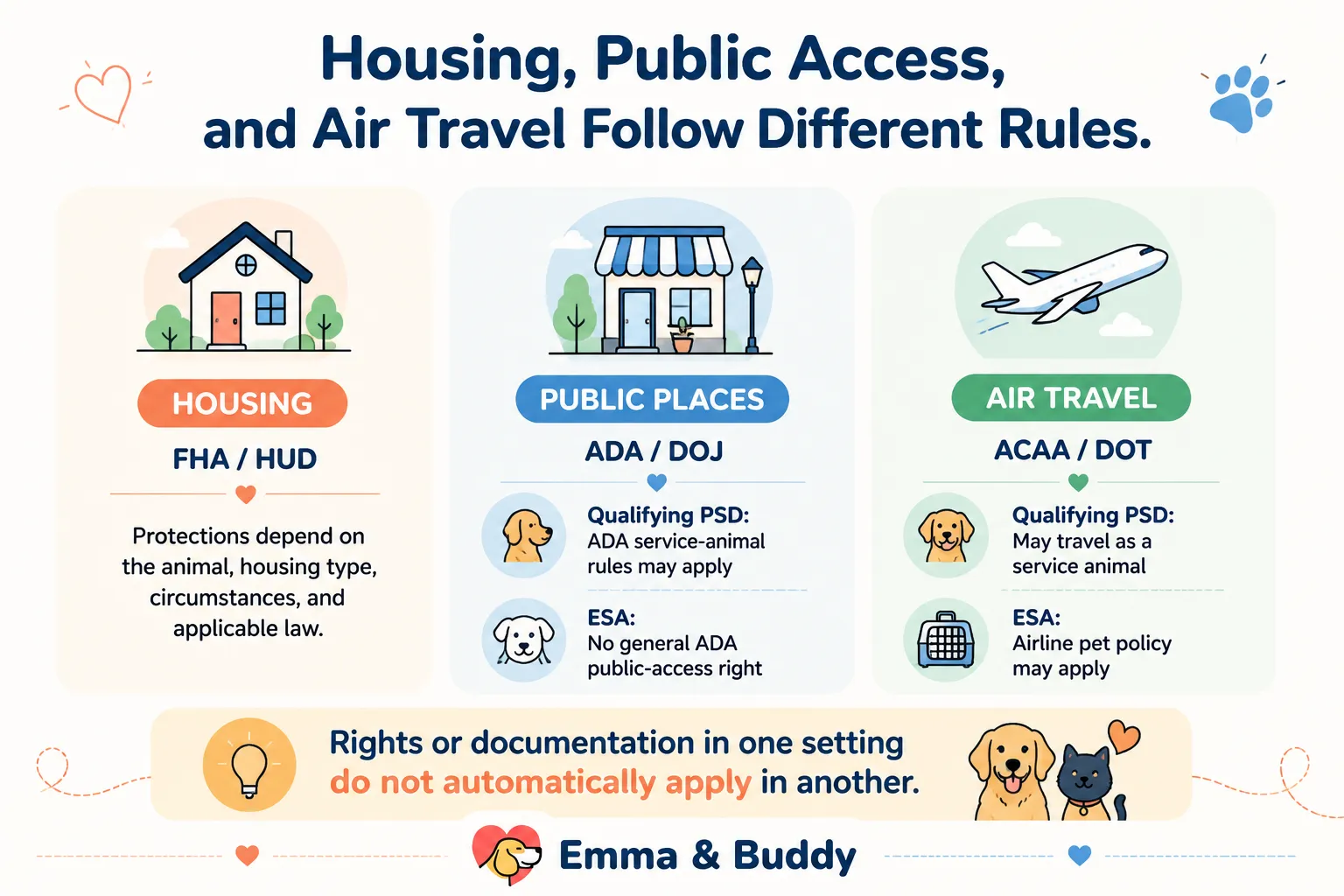
ESA and PSD rights depend on the setting. Housing falls under fair housing rules, public access for service animals is addressed by the ADA, and air travel is governed by U.S. Department of Transportation rules. Protection in one setting does not automatically create access rights in another.
Do ESAs and PSDs Have Housing Protections?
Not necessarily. In May 2026, the U.S. Department of Housing and Urban Development (HUD) changed its Fair Housing Act enforcement approach. This is an enforcement policy change rather than an amendment to the Fair Housing Act itself, and HUD has indicated it may pursue formal rulemaking on the issue going forward.
When investigating Fair Housing Act complaints, HUD’s Office of Fair Housing and Equal Opportunity now generally limits reasonable-cause findings to cases involving animals individually trained to perform work or tasks related to a person’s disability. Pet-policy accommodations for untrained ESAs are no longer presumed reasonable under this enforcement standard.
This does not mean that every ESA housing request can automatically be denied. Private Fair Housing Act claims remain possible, and other federal, state, or local protections may apply. HUD’s guidance also does not address Section 504 or ADA complaints.
Because housing protections can depend on the animal, housing type, location, and circumstances, check the requirements that apply to your situation.
Can an ESA or PSD Go Into Public Places?
A qualifying psychiatric service dog generally has public-access rights under the Americans with Disabilities Act (ADA). This can include restaurants, stores, hotels, and other businesses open to the public, provided the dog meets applicable service-animal requirements.
An emotional support animal does not have the same general ADA public-access rights. A business can choose to allow an ESA or pets, but ESA status alone does not require a business to admit the animal where pets are otherwise prohibited.
Can a Business Ask for Proof That a PSD Is a Service Dog?
Businesses generally cannot require documentation, certification, or an ID card as proof that a psychiatric service dog is a service animal. When it is not obvious that the dog is a service animal, staff may ask only two questions: whether the dog is required because of a disability and what work or task the dog has been trained to perform.
Public access is not unconditional. A business may require a service dog to leave if, for example, the dog is out of control and the handler does not take effective action to control it, or the dog is not housebroken.
Some state and local laws may provide additional protections for assistance animals, so check the rules that apply where you live.
Can ESAs and PSDs Fly on Airplanes?
Under U.S. Department of Transportation (DOT) rules, a qualifying psychiatric service dog can travel as a service animal on flights covered by the Air Carrier Access Act (ACAA). Airlines may require passengers traveling with a service dog to submit applicable DOT service-animal forms.
Airlines are not required to recognize emotional support animals as service animals. An ESA may instead need to travel under an airline’s pet policy, which can involve fees, carrier or size requirements, and other restrictions.
The key point: housing, public access, and air travel follow different legal frameworks. Documentation used for one purpose does not automatically establish rights in another setting.
ESA Letter vs. PSD Letter: What Documentation Do You Actually Need?
ESA and PSD documentation can be relevant in specific situations, but paperwork does not determine whether an animal is an emotional support animal or psychiatric service dog. What you may need depends on the setting and the type of accommodation you are requesting.
When Might You Need an ESA Letter?
An ESA letter may provide supporting information when requesting a disability-related housing accommodation, but documentation alone does not guarantee that an accommodation must be granted. Whether an ESA accommodation is available depends on the applicable law and circumstances.
An ESA letter also does not give the animal general public-access rights under the ADA.
Do You Need a PSD Letter for Public Access?
No. A PSD letter is not what gives a psychiatric service dog public-access rights under the ADA. Businesses generally cannot require medical documentation, a certificate, registration, or an ID card as proof that a qualifying service dog is allowed to enter.
Documentation requirements can change with the setting. Housing accommodation requests may involve supporting information in certain circumstances, while airlines may require applicable U.S. Department of Transportation service-animal forms.
Do ESAs or PSDs Need to Be Registered or Certified?
There is no federal registration or certification requirement that establishes an ESA’s housing protections or a psychiatric service dog’s ADA status. Purchasing an online registration, certificate, ID card, or vest does not by itself create federal assistance-animal or service-animal rights.
The more useful question is what documentation applies to the setting in which you need support rather than whether your animal needs a certificate or registration.
Need documentation related to a task-trained psychiatric service dog? Review Emma & Buddy’s PSD letter process to understand what the documentation may cover and whether that pathway fits your situation.
ESA or PSD: Which May Fit Your Situation?
An ESA is not automatically a lesser option than a psychiatric service dog, and a PSD is not simply an ESA with broader rights. The relevant path depends on what support the animal provides and where you need that support.
Ask yourself:
- Does my animal primarily help through comfort or companionship? An ESA may be the more relevant category to explore, but housing accommodations depend on the applicable law and circumstances.
- Is my dog individually trained to perform specific actions related to my psychiatric disability? A PSD may be the relevant category if those trained tasks help mitigate the effects of your disability.
- Do I need the animal with me in public places where pets are normally prohibited? ESA status alone does not provide general ADA public-access rights, while a qualifying psychiatric service dog may have those protections.
- Is my main concern housing rather than public access? Assistance-animal rules for housing are different from ADA public-access rules, so the type of accommodation you need matters.
- Do I live in college or university housing? Campus housing may involve its own disability accommodation process, making it important to understand what documentation your school may request.
If you live in campus housing and your animal provides disability-related emotional support, review Emma & Buddy’s ESA guide for college students for the next steps in requesting a housing accommodation.
The goal is not to choose the category with the longest list of protections. It is to understand which category reflects the animal’s actual role and the rules that apply to your situation.
Can an ESA Become a Psychiatric Service Dog?
Potentially, but becoming a psychiatric service dog is not a paperwork or label change. A dog that currently provides emotional support would need to meet the applicable service-animal requirements, including being individually trained to perform work or tasks related to the handler’s disability.
For example:
- Before task training: Your dog’s presence helps calm you during disability-related distress.
- After appropriate task training: Your dog reliably performs a specific learned action related to your disability when that support is needed.
The second situation may involve service-animal work because the dog is performing a trained disability-related task rather than providing comfort through presence alone.
The dog must also meet the requirements that apply to service animals in public, including remaining under control. There is no federal registration or certification process that automatically converts an ESA into a psychiatric service dog.
In other words, the change from ESA to PSD is about the dog’s function and training, not purchasing new documentation.
Understanding the ESA vs. PSD Difference
Understanding which path may apply starts with looking at what your animal actually does. Emotional support through presence and trained disability-related tasks serve different roles and come with different protections. If housing is your primary concern, start by understanding the accommodation rules and documentation requirements that apply to your situation.






 Ask ChatGPT
  Ask Claude
  Ask Perplexity