

ESA Travel & Housing rules have shifted a lot since 2020, and the confusion makes sense. Airlines changed their policies, housing law stayed mostly steady, and a lot of outdated blog posts never got updated. This guide breaks down what your ESA letter actually covers in 2026, what changed for flights, and where a psychiatric service dog fits into the picture.
Protect your housing and traveling rights with an ESA letter you can trust. Whether you’re moving into a new rental or responding to a landlord’s request, Emma & Buddy connects you with licensed mental health professionals for ESA evaluations that support Fair Housing Act accommodations.
What ESA Travel & Housing Documentation Covers in 2026
An ESA letter is a formal document issued by a licensed mental health professional (LMHP) confirming that you have a qualifying mental or emotional health condition and that an emotional support animal is part of your treatment plan. Unlike online certificates, registration badges, or purchased ID cards, a legitimate ESA letter is the only documentation generally recognized for housing accommodations.
In 2026, the value of an ESA letter is centered on housing not air travel. Under the Fair Housing Act (FHA), individuals with a valid ESA letter may request a reasonable accommodation that allows them to live with their emotional support animal, even in many properties that otherwise prohibit pets. These protections can apply to apartments, condominiums, rental homes, and other qualifying housing, provided the request meets applicable legal requirements.
Air travel follows a completely different set of rules. Since the U.S. Department of Transportation’s 2021 regulatory change, airlines are no longer required to recognize ESA as service animals. As a result, most carriers now classify ESAs as pets, meaning travelers should expect standard pet fees, carrier requirements, and airline-specific restrictions rather than disability-related accommodations.
This distinction is why ESA Travel & Housing remains one of the most misunderstood topics online. Housing rights are primarily governed by federal fair housing laws, while airline policies are determined by individual carriers. Understanding which rules apply to your situation helps you avoid outdated information, unexpected costs, and unnecessary delays when renting a home or planning a trip.
ESA Travel & Housing Rights for Renters Under the Fair Housing Act
Understanding your ESA Travel & Housing rights starts with knowing what the Fair Housing Act (FHA) actually protects. While an ESA does not receive the same legal treatment in every setting, federal housing law provides important protections for eligible renters with a valid ESA letter.
- Reasonable accommodation for your ESA: The FHA generally requires covered housing providers to make reasonable accommodations for tenants with a documented need for an emotional support animal, even in properties with a “no-pets” policy.
- No pet fees or pet rent: Landlords generally cannot charge pet deposits, monthly pet rent, or other pet-related fees for a properly documented emotional support animal because an ESA is not legally treated as a pet under the FHA.
- Breed and size restrictions may not apply: Blanket breed, weight, or size restrictions that apply to pets generally cannot be used to deny a legitimate ESA accommodation request.
- Documentation can be requested: If your disability or disability-related need for the animal is not readily apparent, a landlord may request a valid ESA letter from a licensed mental health professional supporting the accommodation request.
- Your medical privacy is protected: Housing providers may verify your need for an ESA, but they cannot require your complete medical records, detailed treatment history, or a specific diagnosis simply to evaluate your request.
- Landlords still have legitimate responsibilities: An approved ESA does not excuse aggressive behavior, uncontrolled disturbances, or property damage. Tenants remain responsible for ensuring their animal behaves appropriately and for paying for damage caused by animal.
- Some housing exemptions exist: Although the FHA covers most rental properties, certain limited housing providers may qualify for exemptions under federal law. State and local housing regulations may also affect how ESA accommodations are handled.
| Housing (Fair Housing Act) | Air Travel (Airline Policies) |
|---|---|
| Governing rules: Fair Housing Act (FHA) & HUD | Governing rules: Airline policies after the DOT’s 2021 rule change |
| ESA letter: Supports housing accommodation requests | ESA letter: Generally not accepted for flight accommodations |
| No-pet housing: May still qualify for an ESA accommodation | Travel status: ESAs are usually treated as pets |
| Pet fees: No pet deposit or monthly pet rent for approved ESAs | Pet fees: Standard airline pet fees usually apply |
| Breed/size rules: Blanket pet restrictions generally don’t apply | Breed/size rules: Subject to each airline’s requirements |
| Documentation: Valid ESA letter may be required | Documentation: Follow the airline’s pet travel requirements |
| Medical privacy: No detailed medical records or diagnosis required | Medical privacy: ESA documentation typically provides no travel benefit |
| Owner responsibilities: Animal must be well-behaved; damage remains the tenant’s responsibility | Owner responsibilities: Follow carrier, check-in, and pet travel rules |
| Primary purpose: Protects housing rights | Primary purpose: Governs pet travel requirements |
Understanding these protections helps renters separate housing rights from travel rules, avoiding many of the misconceptions surrounding ESA Travel & Housing in 2026. Before signing a lease or submitting an accommodation request, make sure your ESA documentation is current and follows applicable federal and state requirements.
ESA Travel & Housing Letter Requirements Landlords Can Ask For
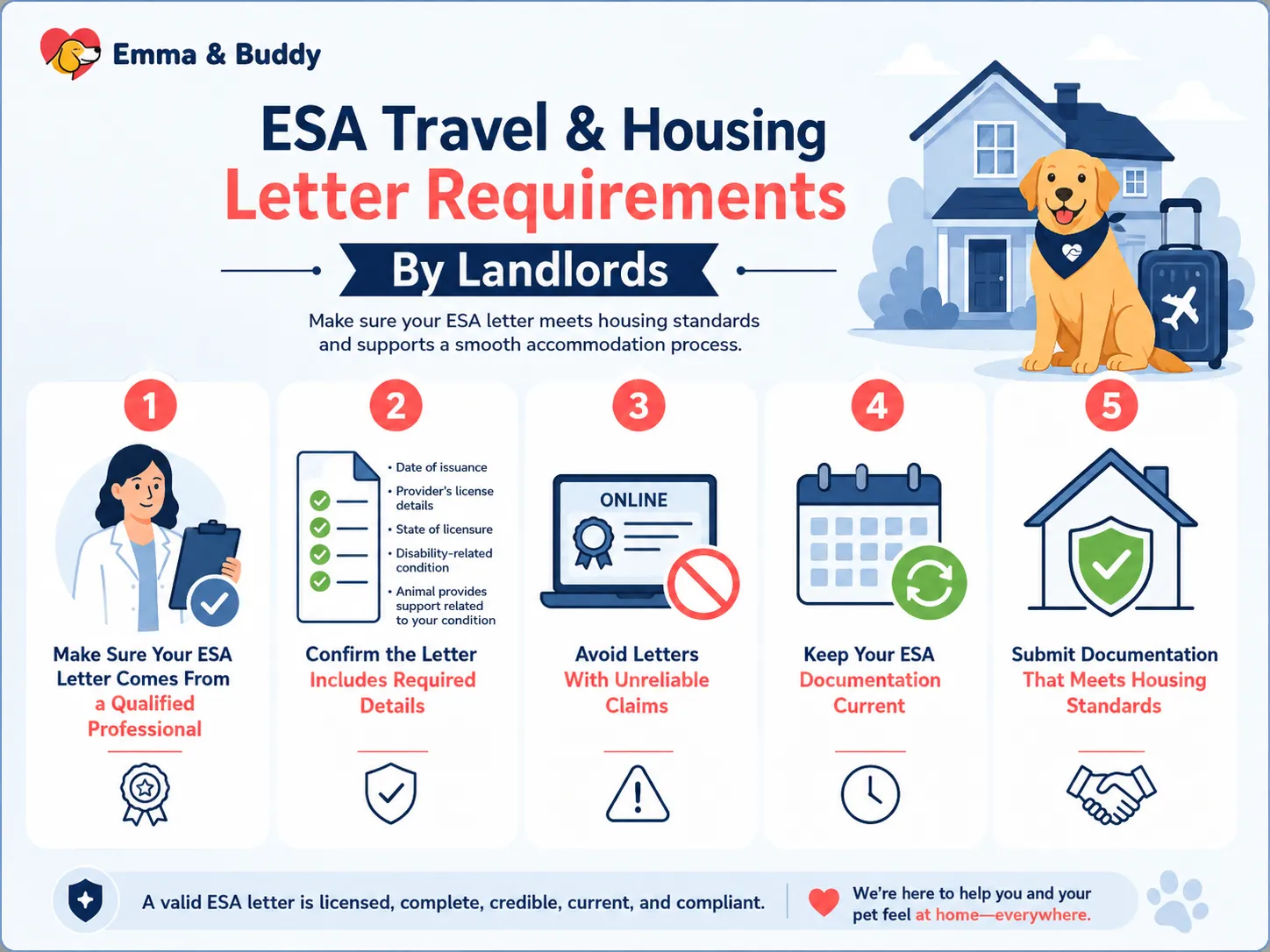
Make Sure Your ESA Letter Comes From a Qualified Professional
A legitimate ESA housing request starts with a valid letter from a licensed mental health professional. Landlords are increasingly familiar with generic online certificates and may question documentation that does not show a proper clinical evaluation. A strong ESA letter should come from a qualified provider who can verify your disability-related need for an emotional support animal.
Confirm the Letter Includes Required Details
A properly prepared ESA letter should include essential information that helps a landlord evaluate your accommodation request. This typically includes the date of issuance, the provider’s license details, the state where the provider is licensed, and confirmation that you have a mental or emotional health condition that substantially limits one or more major life activities. The letter should also explain that your animal provides support related to your condition.
Avoid Letters With Unreliable Claims
A valid ESA letter should focus on your disability-related need, not promises or guarantees. It should not claim instant housing approval, come only from an online registry, or be issued without involvement from a licensed professional. Under HUD guidance, documentation from unreliable internet sources alone may not be enough when a disability or need for an assistance animal is not obvious.
Keep Your ESA Documentation Current
ESA letters should be updated regularly because a person’s condition, treatment plan, or need for an emotional support animal may change over time. Many housing providers expect recent documentation, so maintaining a current letter can help prevent delays when submitting a new accommodation request or moving to a different property.
Submit Documentation That Meets Housing Standards
A well-prepared ESA letter makes the housing request process smoother by clearly showing the connection between your condition and your animal’s support role. When your documentation follows Fair Housing Act requirements, it is easier for landlords and property managers to properly review your accommodation request.
If you want a letter that actually stands up to landlord scrutiny, get started with an ESA housing letter built around what housing providers are trained to check for.
ESA Travel & Housing Rules for Air Travel Since 2021
Before 2021, an ESA letter often got you a free seat next to your emotional support animal on most major airlines. That changed with a federal rule from the U.S. Department of Transportation.
The DOT final rule on traveling by air with service animals redefined “service animal” for air travel purposes. Under the new definition, only a dog individually trained to perform a specific task for a person with a disability qualifies. Emotional support animals, no matter how much comfort they provide, no longer meet that bar.
The rule itself is detailed and technical, Federal Register explains the reasoning: rising complaints, inconsistent species showing up in cabins, and safety concerns from crew and other passengers.
In practice, this means most U.S. airlines now treat ESAs like any other pet. You’ll likely pay a cabin pet fee, follow carrier size limits, and stick to approved species (usually dogs and cats). Some international carriers still have their own, more flexible rules, so it always pays to check before booking.
Flying overseas soon? Get knowledge about traveling with an ESA internationally its country-by-country expectations and how airline rules differ from destination rules.
ESA Travel & Housing and Psychiatric Service Dogs: Where PSD May Apply
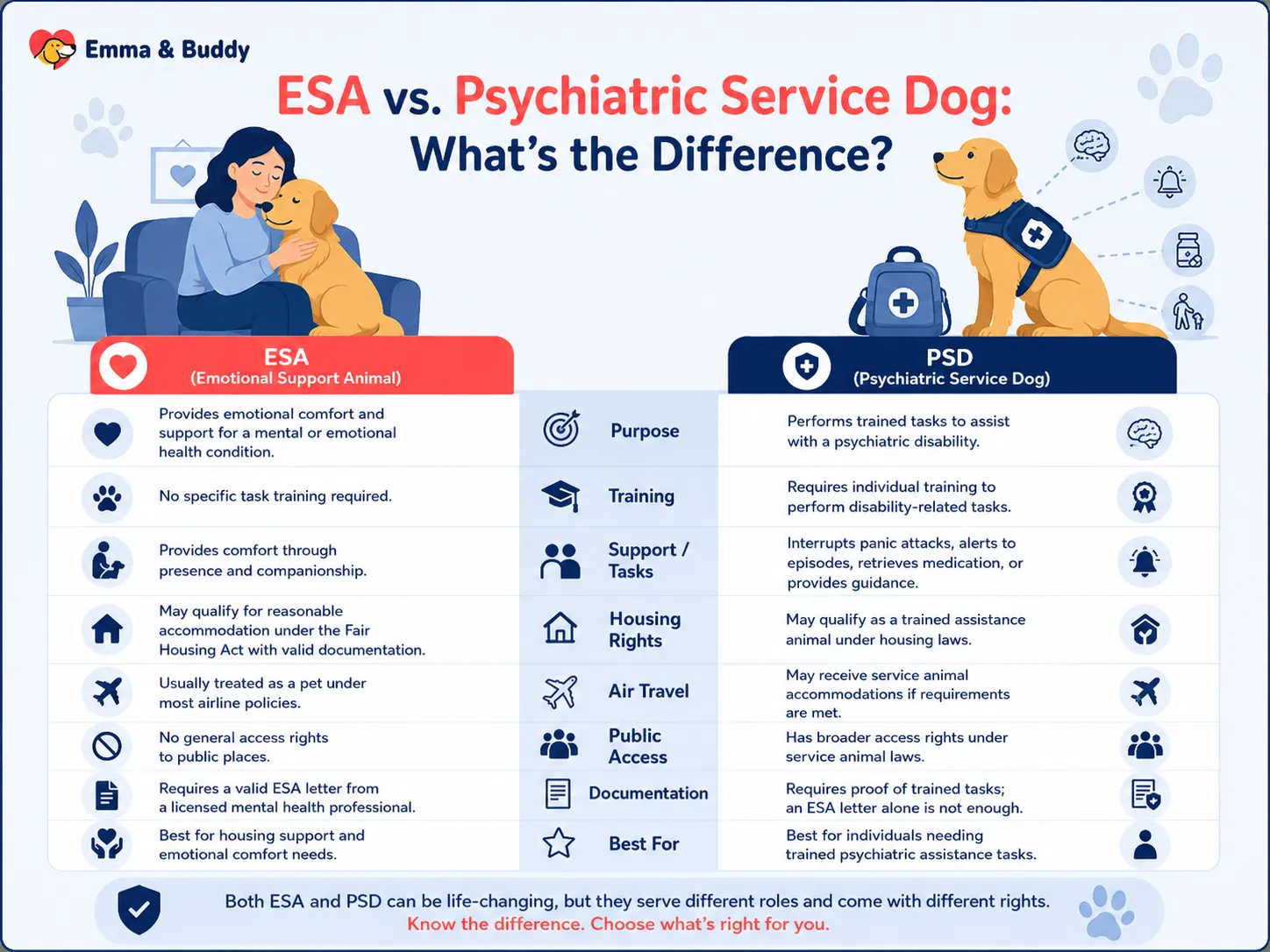
- An emotional support animal provides comfort and emotional support, while a psychiatric service dog (PSD) is trained to perform specific tasks related to a person’s disability.
- Under the Americans with Disabilities Act (ADA), a psychiatric service dog must be a dog trained to perform specific work or tasks connected to a disability. Simply offering companionship, comfort, or emotional reassurance does not qualify as a service animal task.
- A PSD may perform trained tasks such as interrupting a panic attack, alerting to signs of an upcoming anxiety episode, retrieving medication, or guiding a person to safety during periods of disorientation.
- An animal that helps someone feel calmer just by being present may provide meaningful emotional support, but that role falls under an ESA rather than a psychiatric service dog.
- Because qualified PSDs meet service animal definitions under applicable laws, they generally have protections that ESAs do not, including broader public access rights and certain air travel protections.
- After the DOT’s 2021 rule change, airlines generally stopped treating ESAs as service animals. A properly trained PSD may still qualify for service animal travel accommodations when it meets airline and regulatory requirements.
- Transitioning from an ESA to a PSD is not automatic. The dog must have the right temperament, receive appropriate task training, and meet the handler’s disability-related needs.
- If your main goal is housing accommodation, an ESA may be appropriate. If you need public access or travel support, discuss whether a psychiatric service dog evaluation is suitable with a qualified mental health professional.
ESA Travel & Housing Costs and Timelines in 2026
Budgeting for ESA Travel & Housing needs looks different depending on which side you’re planning for.
On the housing side, your main cost is the letter itself, plus any renewal down the line. There should be no ongoing landlord fees once your accommodation is approved, since pet deposits and pet rent don’t apply to a properly documented ESA.
| Category | Typical Cost or Timeline (2026) |
|---|---|
| ESA housing letter | Provider-dependent, often processed within 24 to 48 hours |
| Landlord pet deposit for ESA | $0 (not permitted under the FHA) |
| Airline cabin pet fee (most U.S. carriers) | Set by each airline’s standard pet policy |
| PSD evaluation and task training | Longer timeline, often months, since training must be verified |
| Letter renewal | Roughly every 12 months |
On the travel side, costs run through the airline, not your letter. Since ESAs fall under standard pet policy now, expect a cabin fee, carrier requirements, and possibly health documentation for your animal, especially for international routes.
Timelines matter just as much as cost. A housing letter can often move fast once you’ve had a genuine evaluation. A PSD path takes longer, since legitimate task training cannot be rushed or faked for a form.
Common ESA Travel & Housing Mistakes That Cause Denials
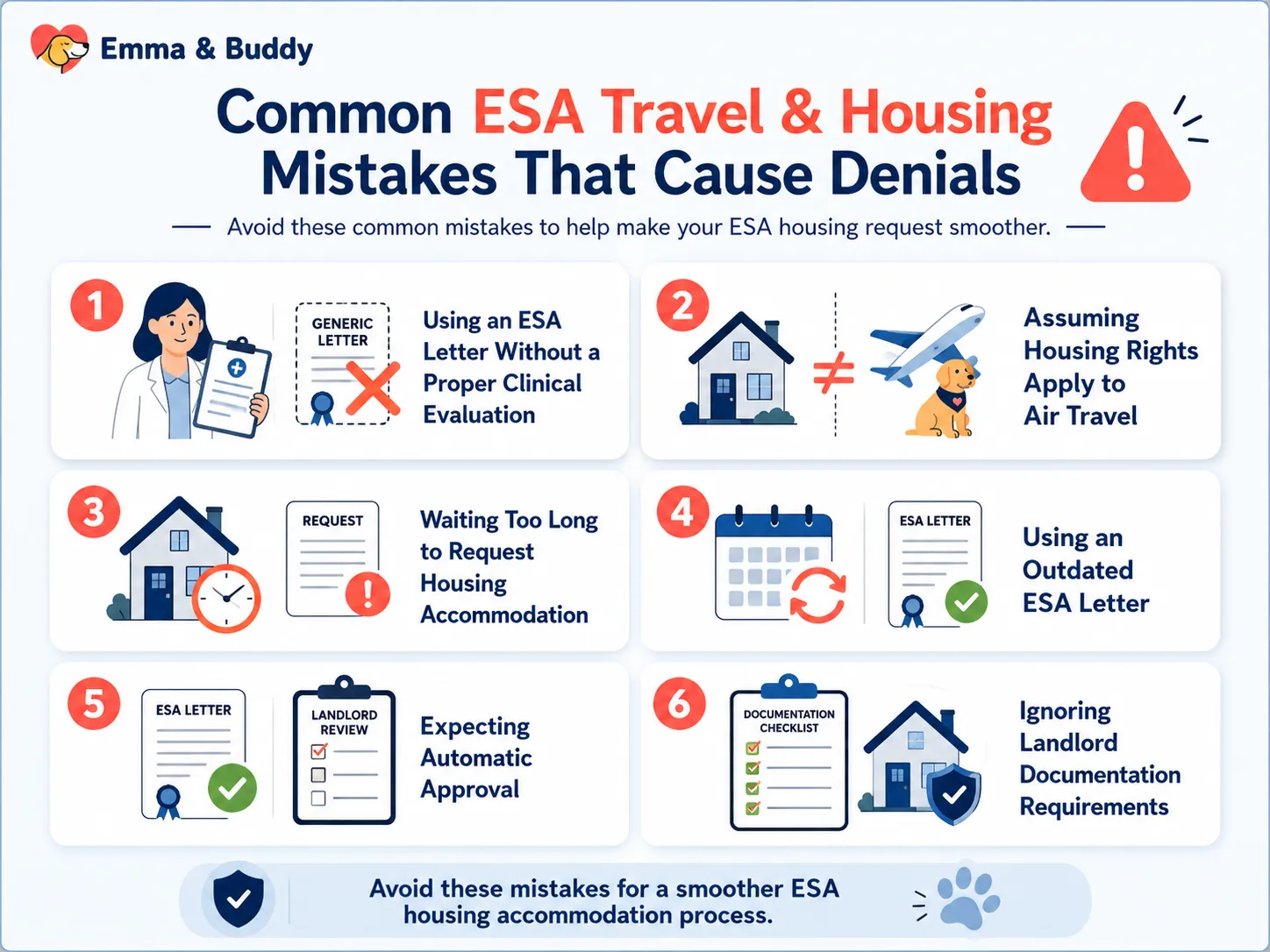
-
Using an ESA letter without a proper clinical evaluation
One of the biggest reasons ESA requests face challenges is documentation from websites that skip a real evaluation process. Generic template letters, missing provider details, or documents from unreliable sources are more likely to be questioned by landlords.
Assuming ESA housing rights apply to flights
Housing and air travel follow different rules. An ESA letter that supports a housing accommodation request does not automatically allow an animal to fly without fees or restrictions. Most airlines now treat emotional support animals as pets under their current policies.
Waiting too long to request a housing accommodation
Delaying your ESA accommodation request can create unnecessary complications. Submitting your request before moving in or soon after signing a lease often makes the process smoother than waiting until a landlord raises a no-pets policy concern.
Using an outdated ESA letter
ESA documentation is not permanent. Older letters may no longer reflect your current need or treatment situation. Keeping your ESA letter updated helps avoid delays when requesting accommodations from a landlord or property manager.
Expecting automatic approval from an ESA letter
An ESA letter supports a reasonable accommodation request, but it does not guarantee approval in every situation. Housing providers may still review whether the request meets legal requirements under the Fair Housing Act.
Failing to understand landlord documentation requirements
A strong ESA request includes reliable documentation from a licensed mental health professional that clearly connects your condition with your need for an emotional support animal. Missing details can slow down the review process or lead to additional questions.
Conclusion
The gap between ESA Travel & Housing rules comes down to one simple fact: housing law protects you, and airline policy generally does not anymore. Your letter still carries real weight with a landlord under the Fair Housing Act, waiving pet fees and no-pets restrictions in most cases. At the airport, that same letter usually won’t waive a pet fee or override a carrier’s size limits, since the DOT narrowed its service animal definition back in 2021.
If air travel access matters as much as housing to you, a conversation about psychiatric service dog training may be worth having with your provider, since PSDs keep broader legal protections that ESAs lost. For most renters, though, a properly written, current ESA letter still does exactly what it’s meant to do: it protects your right to live with the animal that supports your mental health.
Ready to get documentation that actually holds up with a landlord? Start your ESA housing letter today and get a letter built around what housing providers actually check for.






 Ask ChatGPT
  Ask Claude
  Ask Perplexity