

You’re getting ready to move into college housing, but there’s one question you need answered before move-in day: can your emotional support animal come with you? Most colleges have no-pet policies, yet many students with disabilities can request housing accommodations for an emotional support animal. Knowing what documentation your school may request, when to start the process, and how to work with your university housing office can make the difference between a smooth move-in and last-minute delays.
This guide explains what college students should know about requesting an emotional support animal (ESA) accommodation for campus housing. You’ll learn when to begin preparing before move-in, what documentation your university may request, how to communicate with your housing office, and practical steps that can help you stay organized throughout the accommodation process.
Can You Have an Emotional Support Animal in College Housing?
Yes, many college students with disabilities may be able to keep an emotional support animal (ESA) in campus housing, even if their college has a no-pets policy. Colleges and universities that provide student housing typically have accommodation processes that allow eligible students to request an exception when an ESA is needed because of a disability.
It’s important to understand that housing accommodations are different from public-access rights. The Americans with Disabilities Act (ADA) distinguishes service animals from emotional support animals.
An ESA may be permitted in a student’s dorm room, residence hall, or other university housing after an accommodation request is approved. However, ESA status alone does not allow the animal to accompany the student into classrooms, libraries, dining halls, or other campus buildings where pets are not normally allowed.
Every college has its own accommodation process, deadlines, and documentation requirements. Some schools route requests through the housing office, while others work through disability services or an accessibility office. Starting early gives you more time to understand your school’s process and respond if additional information is requested.
If you plan to live off campus instead of in university housing, your accommodation process may be different from your school’s campus housing procedures.
The next section walks through a practical timeline so you know what to do before move-in day.
Timeline: When Should You Start the ESA Process Before Move-In?
Starting early gives you more time to gather documentation, understand your school’s accommodation process, and respond if the housing office requests additional information. Exact deadlines vary by college, but using a general timeline can help you stay on track before move-in day.
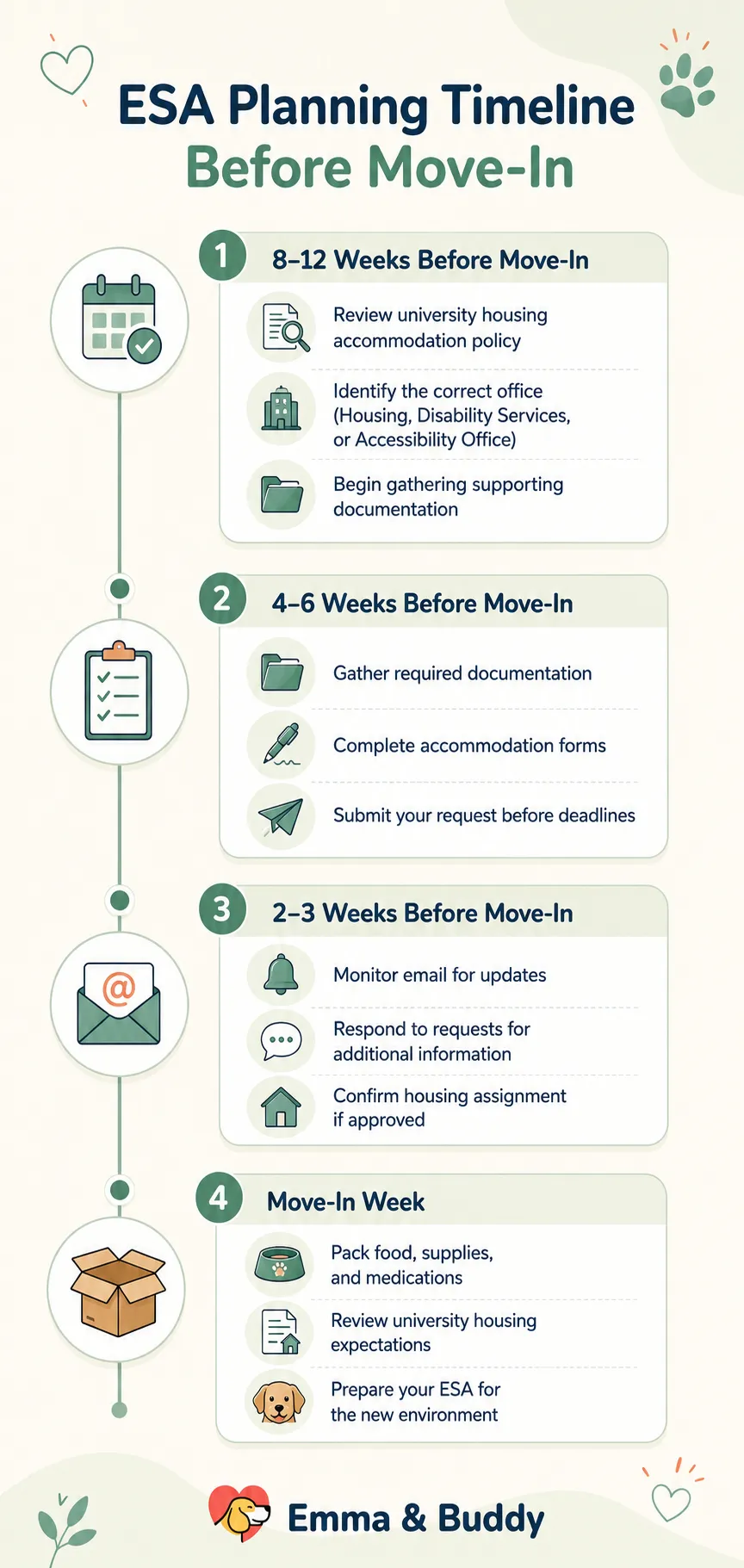
8–12 Weeks Before Move-In
Review your university’s housing accommodation policy and note any submission deadlines. Identify which office handles ESA requests, such as the housing office, disability services, or accessibility office. If you don’t already have appropriate supporting documentation, this is also a good time to begin that process.
4–6 Weeks Before Move-In
Gather the documentation your college requires and complete any required accommodation forms. Review everything carefully before submitting your request to avoid delaying the process due to missing information.
2–3 Weeks Before Move-In
Check your email regularly in case the university requests clarification or additional documentation. If your request has been approved, confirm your housing assignment and keep a copy of your written accommodation approval.
Move-In Week
Prepare your ESA for the new environment by bringing familiar supplies, food, medications, and any records your university has asked you to keep available. Once you move in, follow your school’s housing policies and be considerate of roommates and shared spaces.
Starting several weeks before move-in can make the accommodation process much less stressful and reduce the chances of last-minute complications.
What Documentation May Your College Request?
The documentation a college requests can vary, but most schools have a formal accommodation process for students requesting an emotional support animal (ESA) in campus housing. Before submitting your request, review your university’s housing policy so you understand exactly what information and forms are required.
Many colleges ask students to provide supporting documentation as part of their reasonable accommodation request. Depending on the school, this may include an ESA letter and additional university-specific forms completed during the housing accommodation process. Some institutions may also have submission deadlines that students must meet before housing assignments are finalized.
Keep copies of all forms, supporting documentation, and correspondence you submit throughout the accommodation process. Providing complete and accurate documentation the first time can help avoid unnecessary delays.
If you’re ready to begin preparing your documentation, learn more about Emma & Buddy’s ESA documentation process for college students and what to expect before submitting your request.
What Information Can’t a College Usually Require?
While colleges may request documentation to evaluate a housing accommodation request, they generally should not require more information than is necessary to review that request. For example, schools do not typically need your full medical records simply because you requested an ESA accommodation.
What Can Delay an ESA Housing Request?
Starting the accommodation process early is one of the best ways to avoid unnecessary delays before move-in. Even when a student qualifies for an accommodation, waiting until the last minute or overlooking university requirements can make the process more stressful.
Some common reasons an ESA housing request may take longer include:
- Waiting until housing assignments are almost finalized before submitting your request.
- Missing required documentation or university accommodation forms.
- Sending incomplete information that requires follow-up from the housing office.
- Overlooking submission deadlines or required next steps.
- Taking too long to respond if the university requests additional information.
Not every delay results in a denial, but it can affect how quickly your request is reviewed. Reading your school’s housing policy, preparing your documentation in advance, and checking your email regularly can help keep the process moving.
If you’re unsure what documentation your college may expect, reviewing the requirements before you apply can save time and help you submit a more complete request.
How to Talk With Your University Housing Office
Your university’s housing office, disability services office, or accessibility office is there to guide students through the accommodation process. Before reaching out, take a few minutes to understand your school’s requirements so you can ask clear, specific questions and provide the information they need.
When contacting the office, it can help to have the following ready:
- Your student ID or housing application information.
- The university’s accommodation request forms, if applicable.
- Any supporting documentation your school has asked you to submit.
- A list of questions about deadlines, housing assignments, or the review process.
If the university requests additional information, respond as soon as you can and keep copies of any emails or documents you exchange. Staying organized and communicating promptly can help the accommodation process move more smoothly.
Remember that every college has its own policies and review process. If you’re unsure about a requirement, ask for clarification rather than making assumptions. It’s always better to confirm what’s needed before move-in than to discover a missing step later.
College Housing Accommodation Checklist
Before move-in, use this checklist to make sure you’ve completed the most important steps in your university’s accommodation process.
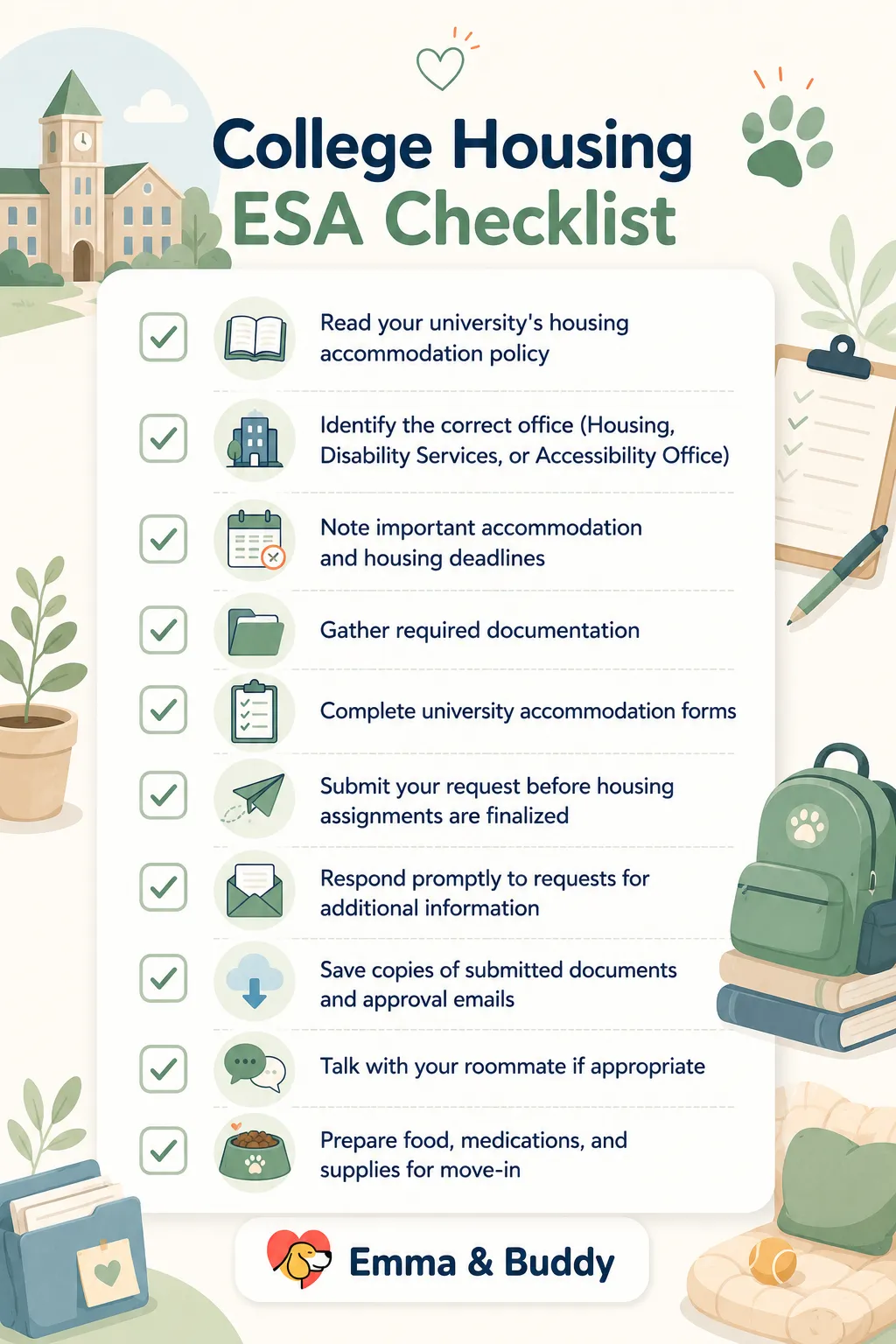
- Read your university’s housing accommodation policy.
- Identify whether requests go through the housing office, disability services, or accessibility office.
- Note all accommodation and housing deadlines.
- Gather the documentation your college requires.
- Complete any university accommodation forms.
- Submit your request before housing assignments are finalized, if possible.
- Respond promptly if the university requests additional information.
- Save copies of your submitted forms, supporting documentation, approval emails, and any written accommodation approval.
- Discuss living arrangements with your roommate if your university recommends or requires it.
- Prepare your ESA’s food, medications, supplies, and any records your university asks you to keep available for move-in.
Completing these steps before move-in can help you stay organized and reduce last-minute surprises during the housing accommodation process.
Can a College Deny an ESA Request?
It depends on the specific circumstances.
Colleges and universities generally review each accommodation request individually, considering the documentation provided, the applicable laws, and the institution’s housing policies. The U.S. Department of Housing and Urban Development (HUD) provides guidance on reasonable accommodation requests involving assistance animals under federal housing law.
A request is not automatically approved simply because a student has an emotional support animal, but it should also not be denied solely because the university has a no-pets policy. The accommodation process is intended to evaluate whether a reasonable housing accommodation is appropriate based on the individual request.
If your university needs additional information, respond promptly and provide any requested documentation through the appropriate office. If you receive a decision you don’t understand, ask the housing office or disability services office to explain the next steps and any available review or appeal process under your school’s policies.
Understanding your university’s accommodation process, submitting complete documentation, and allowing enough time before move-in can help reduce delays and make the review process smoother.
Living With an ESA in College
Bringing an emotional support animal to college is more than completing the accommodation process. Living successfully with an ESA in campus housing also means being prepared for the responsibilities of caring for your animal while sharing a residential community with other students.
Here are a few practical ways to make the transition easier:
- Maintain your ESA’s daily routine. Regular feeding, exercise, and bathroom breaks can help your animal adjust to a new environment.
- Be considerate of roommates, neighbors, and your university’s expectations for responsible animal care to help maintain a positive living environment for everyone.
- Follow your university’s housing policies. Even after an accommodation is approved, students are generally expected to comply with residence hall rules related to animal care and conduct.
- Plan for weekends, holidays, and school breaks. Think ahead about who will care for your ESA if you travel or if campus housing closes during academic breaks.
- Know who to contact if questions arise. Save the contact information for your housing office or disability services office in case you need assistance during the school year.
Preparing for everyday life with your ESA can make the transition to college smoother for both you and your animal while helping you get the most from your campus housing experience.
Preparing for College Housing With an ESA
Bringing an emotional support animal to college starts with planning. Understanding your university’s accommodation process, gathering the required documentation, and communicating with the appropriate housing office early can help make move-in smoother and reduce unnecessary delays.
If you’re ready to begin preparing your documentation, learn more about Emma & Buddy’s ESA documentation process for college students and what to expect before submitting your request.






 Ask ChatGPT
  Ask Claude
  Ask Perplexity